HIERARCHY OF RISK CONTROLS FOR ELECTRICAL SAFETY AND WORKPLACE

ELECTRICAL SAFETY RISK CONTROL HIERARCHY TUTORIALS
Basic Information on Hierarchy of Controls

When assessing the adequacy of existing controls or introducing new controls, a hierarchy of risk controls should be considered. The principles of prevention in the MHSW Regulations are not exactly a hierarchy, but must be considered alongside the usual hierarchy of risk controls, which is as follows:

➤ elimination
➤ substitution
➤ changing work methods/patterns
➤ reduced or limited time exposure
➤ engineering controls (e.g. isolation, insulation and ventilation)
➤ good housekeeping
➤ safe systems of work
➤ training and information
➤ personal protective equipment
➤ welfare
➤ monitoring and supervision
➤ review.

Elimination or substitution
This is the best and most effective way of avoiding a severe hazard and its associated risks. Elimination occurs when a process or activity is totally abandoned because the associated risk is too high.
Image result for eliminate risk
Substitution describes the use of a less hazardous form of the substance. There are many examples of substitution, such as the use of waterbased rather than oil-based paints, the use of asbestos substitutes and the use of compressed air as a power source rather than electricity. Care must be taken not to introduce additional hazards and risks as a result of a substitution.

Changing work methods/patterns
In some cases it is possible to change the method of working so that exposures are reduced. For example use rods to clear drains instead of strong chemicals; use disposable hooks for holding articles being sprayed instead of exposing people during the cleaning of reusable hooks.


Sometimes the pattern of work can be changed so that people can do things in a more natural way, for example when removing components and packing them consider whether people are right or left handed; encourage people in offi ces to take breaks from computer screens by getting up to photocopy, fetch files or printed documents.

Reduced time exposure
This involves reducing the time during the working day that the employee is exposed to the hazard, either by giving the employee other work or rest periods. It is only suitable for the control of health hazards associated with, for example, noise, display screens and hazardous substances.


However, it is important to note that for many hazards there are short-term exposure limits as well as normal working workplace exposure limits (WELS) over an 8-hour perio. Short term limits must not be exceeded during the reduced time exposure intervals.

Engineering controls
This describes the control of risks by means of engineering design rather than a reliance on preventative actions by the employee. There are several ways of achieving such controls:

1. control the risks at the source (e.g. the use of more efficient dust filters or the purchase of less noisy equipment)
2. control the risk of exposure by:
– isolating the equipment by the use of an enclosure, a barrier or guard
– insulating any electrical or temperature hazard
– ventilate away any hazardous fumes or gases, either naturally or by the use of extractor fans and hoods.
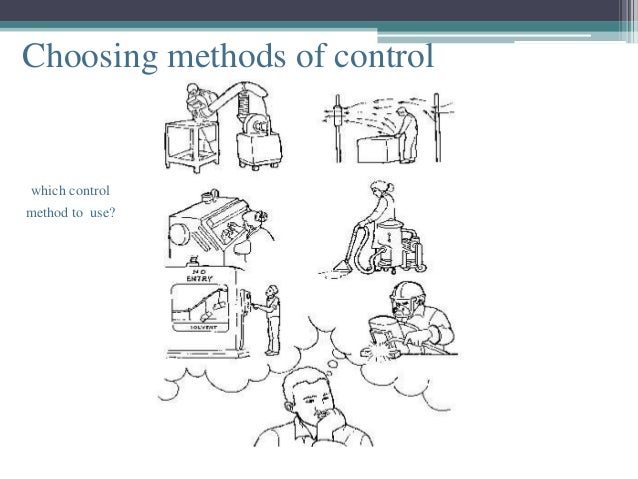
Image result for engineering control
Housekeeping
Housekeeping is a very cheap and effective means of controlling risks. It involves keeping the workplace clean and tidy at all times and maintaining good storage systems for hazardous substances and other potentially dangerous items. The risks most likely to be influenced by good housekeeping are fire and slips, trips and falls.
Image result for plant housekeeping
Safe systems of work
A safe system of work is a requirement of the HSW Act and is dealt with in detail later. The system of work describes the safe method of performing the job activity. If the risks involved are high or medium, the details of the system should be in writing and should be communicated to the employee formally in a training session. Systems for low risk activities may be conveyed verbally. There should be records that the employee (or contractor) has been trained or instructed in the safe system of work and that he or she understands it and will abide by it.

Training and information
Both these topics are important but should not be used in isolation. Information includes such items as signs, posters, systems of work and general health and safety arrangements.

Personal protective equipment
Personal protective equipment (PPE) should only be used as a last resort. There are many reasons for this. The most important limitations are that PPE:
Image result for ppe last resort
➤ only protects the person wearing the equipment not others nearby
➤ relies on people wearing the equipment at all times
➤ must be used properly
➤ must be replaced when it no longer offers the correct level of protection. This last point is particularly relevant when respiratory protection is used.

The benefits of PPE are:
➤ it gives immediate protection to allow a job to continue while engineering controls are put in place
➤ in an emergency it can be the only practicable way of effecting rescue or shutting down plant in hazardous atmospheres
➤ it can be used to carry out work in confi ned spaces where alternatives are impracticable. But it should never be used to allow people to work in dangerous atmospheres, which are, for example, enriched with oxygen or explosive.

Welfare
Welfare facilities include general workplace ventilation, lighting and heating and the provision of drinking water, sanitation and washing facilities. There is also a requirement to provide eating and rest rooms.

Risk control may be enhanced by the provision of eye washing and shower facilities for use after certain accidents. Within this area of welfare, first aid and health surveillance are important services that should be available.

Monitoring and supervision
All risk control measures, whether they rely on engineered or human behavioural controls, must be monitored for their effectiveness and supervised to ensure that they have been applied correctly. Competent people, who have a sound knowledge of the equipment or process, should undertake monitoring. Checklists are useful to ensure that no significant factor is forgotten.
Image result for safety checklist
Any statutory inspection or insurance company reports should be checked to see whether any areas of concern were highlighted and if any recommendations were implemented. Details of any accidents, illnesses or other incidents will give an indication of the effectiveness of the risk control measures. Any emergency arrangements should be tested during the monitoring phase, including first aid provision.

It is crucial that the operator should be monitored to ascertain that all relevant procedures have been understood and followed. The operator may also be able to suggest improvements to the equipment or system of work. The supervisor is an important source of information during the monitoring process.

Where the organization is involved with shift work, it is essential that the risk controls are monitored on all shifts to ensure the uniformity of application. The effectiveness and relevance of any training or instruction given should be monitored.

Review
Periodically the risk control measures should be reviewed. Monitoring and other reports are crucial for the review to be useful. Reviews often take place at safety committee and/or at management meetings. A serious accident or incident should lead to an immediate review of the risk control measures in place.

ELECTRICAL HAZARDS GENERAL CONTROL MEASURES BASIC INFORMATION AND TUTORIALS

General control measures for electrical hazards
Image result for electrical hazards
The principal control measures for electrical hazards are contained in the statutory precautionary requirements covered by the Electricity at Work Regulations. They are applicable to all electrical equipment and systems found at the workplace and impose duties on employers, employees and the self-employed.

The regulations cover the following topics:

S the design, construction and maintenance of electrical systems, work activities and protective
equipment
S the strength and capability of electrical equipment
S the protection of equipment against adverse and hazardous environments
S the insulation, protection and placing of electrical conductors
S the earthing of conductors and other suitable precautions
S the integrity of referenced conductors
S the suitability of joints and connections used in electrical systems
S means for protection from excess current
S means for cutting off the supply and for isolation
S the precautions to be taken for work on equipment made dead
S working on or near live conductors
S adequate working space, access and lighting
S the competence requirements for persons working on electrical equipment to prevent danger and injury.
Image result for electrocuted
Detailed safety standards for designers and installers of electrical systems and equipment are given a code of practice published by the Institution of Electrical Engineers, known as the IEE Regulations. While these regulations are not legally binding, they are recognized as a code of good practice and widely used as an industry standard.

The risk of injury and damage inherent in the use of electricity can only be controlled effectively by the introduction of employee training, safe operating procedures (safe systems of work) and guidance to cover specific tasks.

Training is required at all levels of the organization ranging from simple on-the-job instruction to apprenticeship for electrical technicians and supervisory courses for experienced electrical engineers. First aid training related to the need for cardiovascular resuscitation and treatment of electric burns should be available to all people working on electrical equipment and their supervisors.

A management system should be in place to ensure that the electrical systems are installed, operated and maintained in a safe manner. All managers should be responsible for the provision of adequate resources of people, material and advice to ensure that the safety of electrical systems under their control is satisfactory and that safe systems of work are in place for all electrical equipment

For small factories and office or shop premises where the system voltages are normally at mains voltage, it may be necessary for an external competent person to be available to offer the necessary advice.
Image result for electrical danger
Managers must set up a high voltage permit-to-work system for all work at and above 600 volts. The system should be appropriate to the extent of the electrical system involved. Consideration should also be given to the introduction of a permit system for voltages under 600 volts when appropriate and for all work on live conductors.

The additional control measures that should be taken when working with electrical or using electrical equipment are summarized by the following topics:
S the selection of suitable equipment
S the use of protective systems
S inspection and maintenance strategies

SAFETY MONITORING SYSTEM THAT YOU CAN PUT IN PLACE TO DEVELOP SAFETY AWARENESS

SAFETY MONITORING SYSTEM

Safety monitoring is concerned with the measurement and evaluation of safety performance. It may take the following forms:

1. Safety surveys: This is a detailed examination of a number of critical areas of operation or, perhaps, an in-depth study of all health and safety related activities in a workplace.

2. Safety tours: These are an unscheduled examination of a working area, frequently undertaken as a group exercise (eg foreman, safety representative and safety committee member), to assess general compliance with safety requirements (eg fire protection measures and use of machinery safety devices).

3. Safety audits: A safety audit fundamentally subjects each area of an organisation’s activities to a systematic critical examination with the object of minimising injury and loss. It generally takes the form of a series of questions directed to examining factors such as the operation of safe systems of work, compliance with the Statement of Health and Safety Policy and the operation of hazard reporting systems.

4. Safety inspections: A scheduled inspection of a premises or working area to assess levels of legal compliance and observation of company safety procedures. Safety inspections are frequently undertaken by company safety specialists and trade union safety representatives.

5. Safety sampling: A system designed to measure by random sampling the accident potential in a workplace or process by identifying defects in safety performance or omissions. Observers follow a prescribed route through the working area noting deficiencies in performance, eg concerning the wearing of personal protective equipment or the use of correct manual handling techniques.

In some cases, individual topics in the safety sampling exercise are ranked according to importance with a maximum number of points achievable. At the end of the exercise a total score is identified which gives an indication of the performance level at that point in time.

6. Hazard and operability studies: Such studies incorporate the application of formal critical examination to the process and engineering intentions regarding new facilities. The principal aim of such a study is to assess the hazard potential arising from the incorrect operation of equipment and the consequential effects on the facility. Such an operation enables remedial action to be taken at a very early stage.

7. Damage control: Levels of damage are an indication of future accident potential. Damage control operates on the philosophy that non-injury accidents are just as important as injury accidents. The elimination of the causes of accidents resulting in damage to property, plant and products frequently results in a reduction in injury accidents.

ACCIDENT PREVENTION STRATEGIES FOR AND BY MANAGERS AND SUPERVISORS

MEANS OF ACCIDENT PREVENTION THAT CAN BE INITIATED BY MANAGERS

Image result for accident prevention

As a Manager, there are means and ways that can prevent accidents that you may initiate.

Means of preventing accidents
Strategies for preventing accidents take many forms. These include:

1. Prohibition: Some processes and practices may be so inherently dangerous that the only way to prevent accidents is by management placing a total prohibition on that activity. This may take the form of a prohibition on the use of a particular substance, such as an identified toxic substance, or of prohibiting people from carrying out unsafe practices, such as riding on the tines of a fork-lift truck, climbing over moving conveyors or working on roofs without crawlboards.

2. Substitution: The substitution of a less dangerous material or system of work will, in many cases, reduce accident potential. Typical examples are the introduction of remote control handling facilities for direct manual handling operations, the substitution of toluene, a much safer substance, for benzene, and the use of non-asbestos substitutes for boiler and pipe lagging.

3. Change of process: Design or process engineering can usually change a process to ensure better operator protection. Safety aspects of new systems should be considered in the early stages of projects.

4. Process control: This can be achieved through the isolation of a particular process, the use of ‘permit to work’ systems, mechanical or remote control handling systems, restriction of certain operations to highly trained and competent operators, and the introduction of dust and fume arrestment plant.

5. Safe systems of work: Formally designated safe systems of work, with high levels of training, supervision and control, are an important strategy in accident prevention (see below).

6. Personal protective equipment: This entails the provision of items such as safety boots, goggles, aprons, gloves, etc, but is limited in its application as a safety strategy
Image result for accident due to riding forklift
Safe systems of work
A safe system of work is defined as ‘the integration of men, machinery and materials in the correct environment to provide the safest possible working conditions in a particular working area’.

A safe system of work should incorporate the following features:
(a) a correct sequence of operations;
(b) a safe working area layout;
(c) a controlled environment in terms of temperature, lighting, ventilation, dust control, humidity control, sound pressure levels and radiation hazards; and
(d) clear specification of safe practices and procedures for the task in question.

Safe systems of work are generally designed through the technique of ‘job safety analysis’.

HAZARDS OF USING PNEUMATIC TOOLS BASIC INFORMATION AND TUTORIALS

WHAT ARE THE PNEUMATIC TOOLS HAZARD WHEN WORKING?
Hazard of Pneumatic Tools

Image result for PNEUMATIC TOOLS

Pneumatic tools are powered by compressed air and include chippers, drills, hammers, and sanders.
There are several dangers associated with the use of pneumatic tools. First and foremost is the danger of getting hit by one of the tool's attachments or by some kind of fastener the worker is using with the tool.

Pneumatic tools must be checked to see that the tools are fastened securely to the air hose to prevent them from becoming disconnected.

A short wire or positive locking device attaching the air hose to the tool must also be used and will serve as an added safeguard.

If an air hose is more than 12.7 millimeters in diameter, a safety excess flow valve must be installed at the source of the air supply to reduce pressure in case of hose failure.

In general, the same precautions should be taken with an air hose that are recommended for electric cords, because the hose is subject to the same kind of damage or accidental striking, and because it also presents tripping hazards.

When using pneumatic tools, a safety clip or retainer must be installed to prevent attachments such as chisels on a chipping hammer from being ejected during tool operation.

Pneumatic tools that shoot nails, rivets, staples, or similar fasteners and operate at pressures more than 6,890 kPa, must be equipped with a special device to keep fasteners from being ejected, unless the muzzle is pressed against the work surface.

Airless spray guns that atomize paints and fluids at pressures of 6,890 kPa or more must be equipped with automatic or visible manual safety devices that will prevent pulling the trigger until the safety device is manually released.

Eye protection is required, and head and face protection is recommended for employees working with pneumatic tools.

Screens must also be set up to protect nearby workers from being struck by flying fragments around chippers, riveting guns, staplers, or air drills.

Compressed air guns should never be pointed toward anyone. Workers should never "dead-end" them against themselves or anyone else. A chip guard must be used when compressed air is used for cleaning.

Use of heavy jackhammers can cause fatigue and strains. Heavy rubber grips reduce these effects by providing a secure handhold.

Workers operating a jackhammer must wear safety glasses and safety shoes that protect them against injury if the jackhammer slips or falls.

A face shield also should be used. Noise is another hazard associated with pneumatic tools. Working with noisy tools such as jackhammers requires proper, effective use of appropriate hearing protection.